Not just at work. At the dinner table. In your friend group. In the mirror on a good day — and a difficult one.
These six archetypes show up everywhere people try to get something done together. A family planning a holiday. A team navigating a crisis. A friendship under pressure. A relationship finding its rhythm.
The frustration we feel when someone isn’t showing up the way we need them to is rarely about capability. It’s almost always about context. The right person in the wrong place doesn’t just struggle — they take everyone around them down with them.
The green flag tells you what this person looks like when the context fits.
The red flag tells you what mismatch looks like before it becomes damage.
Read both. You’ll recognise someone immediately.
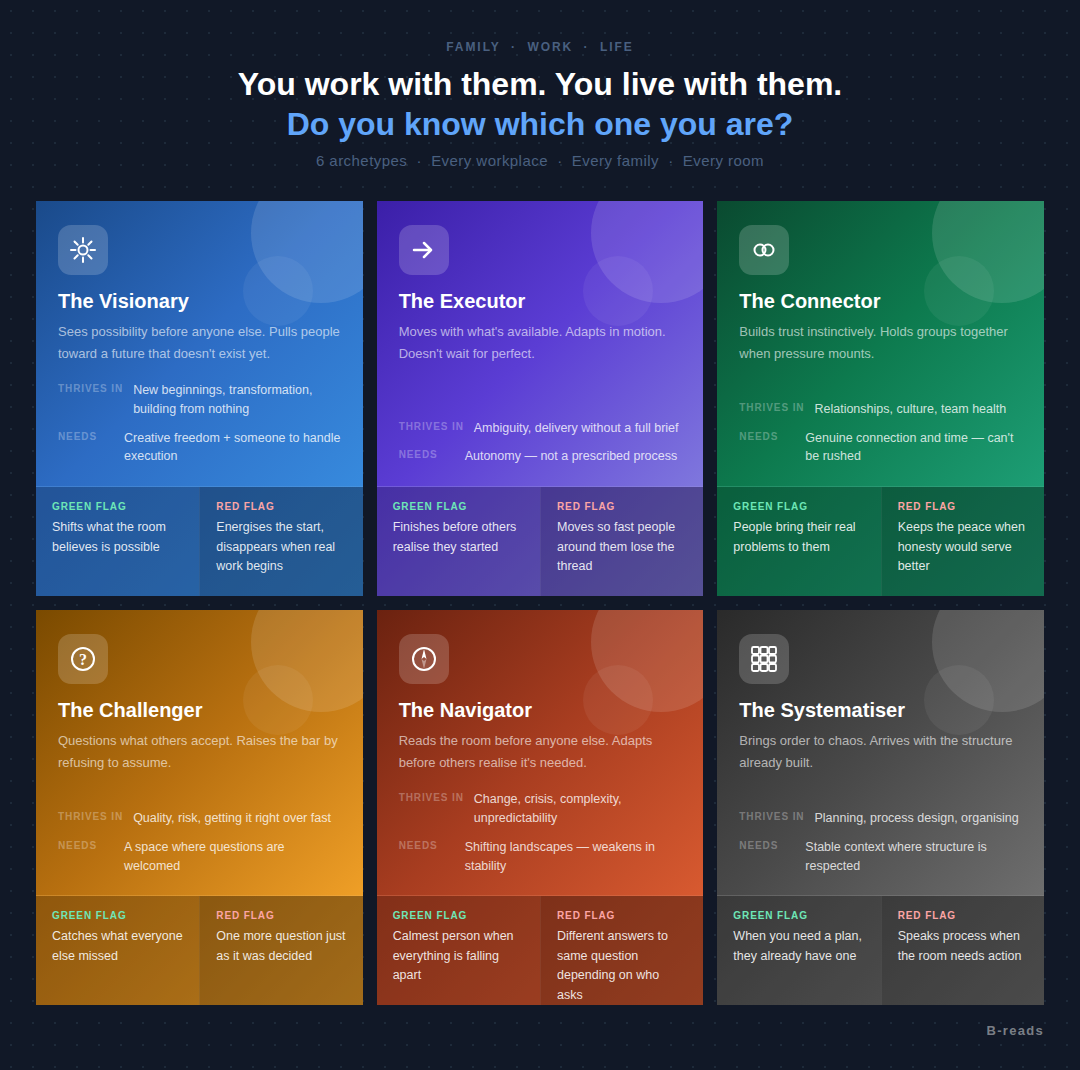
Save this. You’ll recognise all 6 in your life.
The 6 archetypes
Sees possibility before anyone else. Pulls people toward a future that doesn’t exist yet.
Thrives in
New beginnings. Blank canvases. Any situation where the destination isn’t defined yet — a new relationship finding its shape, a family in transition, a team building something no one has built before.
Needs
Creative freedom and someone else to handle the detail. They generate the energy that makes people believe. They need a partner who turns that energy into action.
You know them because
They’re the friend who makes a group holiday sound unmissable before a single booking is made. The partner who reframes a family crisis into an opportunity within minutes. The colleague who walks into a difficult room and leaves it believing something different.
Green flag
Shifts what the room believes is possible
Red flag
Energises the start, disappears when the real work begins
Moves with what’s available. Adapts in motion. Doesn’t wait for perfect.
Thrives in
Situations where momentum matters more than a complete plan. A family that needs someone to just make a decision. A team stuck in analysis. A crisis that needs action, not discussion.
Needs
Autonomy. Not a prescribed process that expects permission before progress. Give them the destination and trust them to find the route.
You know them because
They’ve booked the restaurant before you finished deciding where to eat. They’ve solved the problem while you were still explaining it. They’re three steps ahead in every conversation — which is both their gift and their blind spot.
Green flag
Finishes before others realise they started
Red flag
Moves so fast that the people around them lose the thread
Builds trust instinctively. Holds groups together when pressure mounts.
Thrives in
Any situation where relationships matter more than results in the short term — a family going through difficulty, a friendship group navigating change, a team that needs to rebuild trust before it can perform.
Needs
Time and genuine connection. They can’t be rushed into trust. Give them warmth and they’ll give you loyalty that outlasts any job title or life season.
You know them because
They’re the person everyone calls first when something goes wrong. They know how the group is really feeling before anyone has said it out loud. In a difficult family moment, they’re the one holding everyone together quietly.
Green flag
People bring their real problems to them
Red flag
Keeps the peace when honesty would serve better
Questions what others accept. Raises the bar by refusing to assume.
Thrives in
Situations where getting it right matters more than getting it done — a major family decision, a relationship at a crossroads, a team about to make a costly mistake. They’re the person who catches what everyone else missed.
Needs
A space where questions are welcomed, not experienced as obstruction. In the right environment they’re your most valuable thinking partner.
You know them because
They’re the friend who asks the question nobody wanted asked — and turns out to be right. The partner who reads the contract when you’ve already celebrated. The family member who says “but have we thought about…” just as everyone relaxes.
Green flag
Catches what everyone else missed
Red flag
One more question just as the decision was made — the loop never closes
Reads shifting situations. Adapts approach in real time. Energised by unpredictability.
Thrives in
Change, complexity, anything that keeps moving. A family in transition. A relationship redefining itself. A team in the middle of something no one has a playbook for. They don’t just cope with ambiguity — they come alive in it.
Needs
Constantly shifting landscapes. In stable, predictable environments they quietly disengage. They need the ground to keep moving or they stop growing.
You know them because
They’re the calmest person in the room when everything is falling apart. They pivot mid-conversation and make it look like the plan all along. In a life crisis that destabilises everyone else, they’re already thinking three moves ahead.
Green flag
The calmest person in the room when everything is falling apart
Red flag
Gives different answers to the same question depending on who’s asking
Brings order to chaos. Arrives with the structure already built.
Thrives in
Situations that need organising, process and clarity — a household that needs routine, a family event that needs coordinating, a team that needs a framework to work from.
Needs
A stable environment where structure is respected rather than bypassed. Put them somewhere that values what they build and they create the foundation everyone else builds on.
You know them because
They’re the family member who shares the holiday itinerary three weeks early — and it’s actually useful. The friend who documents the group’s unspoken rules so no one has to guess. The colleague who has already designed the process before the meeting to discuss it has started.
Green flag
When you need a plan, they already have one — complete with rules and structure
Red flag
Speaks process when the room needs action
The question worth sitting with
Most friction — at work and in life — isn’t about people being difficult. It’s about people being misread.
When you place a Systematiser in a context that needs a Navigator, you don’t get bad performance. You get two people who fundamentally can’t understand why the other one doesn’t get it.
When you put an Executor in a relationship that needs a Connector, you don’t get a bad person. You get someone moving fast through moments the other person needed to slow down for.
The archetype isn’t the problem. The context is.
So the next time someone frustrates you — at work or at home — try asking a different question before you judge. Not what’s wrong with this person? But what does this person need that this situation isn’t giving them?
The answer changes everything.
Which one are you? And which one did you recognise in someone else? Share in the comments.

I feel like I’m a mix of the Challenger and the Navigator. My creativity comes out the most under pressure or when things become certain even if it’s a negative outcome. My anxiety peaks when there are too many possible paths because my mind keeps questioning every scenario. But once the uncertainty narrows and there’s a clear direction, I become calm, focused, and surprisingly creative even when the situation I had to deal with wasn’t in my favour.