Tag: Personal Development

The Power of your Subconscious Mind by Dr. Joseph Murphy

Core Theme: Your mind is a “treasure house.” By changing your habitual thinking and mental imagery, you can literally rewire your destiny.

🌟 The Big Idea

Joseph Murphy posits that we have one mind with two distinct functional parts: the Conscious (Objective) and the Subconscious (Subjective).

  • The Conscious Mind is the captain of the ship; it reasons and chooses.
  • The Subconscious Mind is the engine room; it doesn’t argue, it simply obeys the orders (thoughts) sent by the conscious mind.

Chapter 1: The Treasure House Within You

Murphy argues that most people are “magnetized”—they believe they are born to succeed. Others are “demagnetized”—filled with fear and doubt.

  • Key Concept: The Master Secret is the discovery of the subconscious mind.
  • Takeaway: Stop looking for “luck” or external help. The power to heal your body and solve your finances is already inside you.

Chapter 2: How Your Own Mind Works

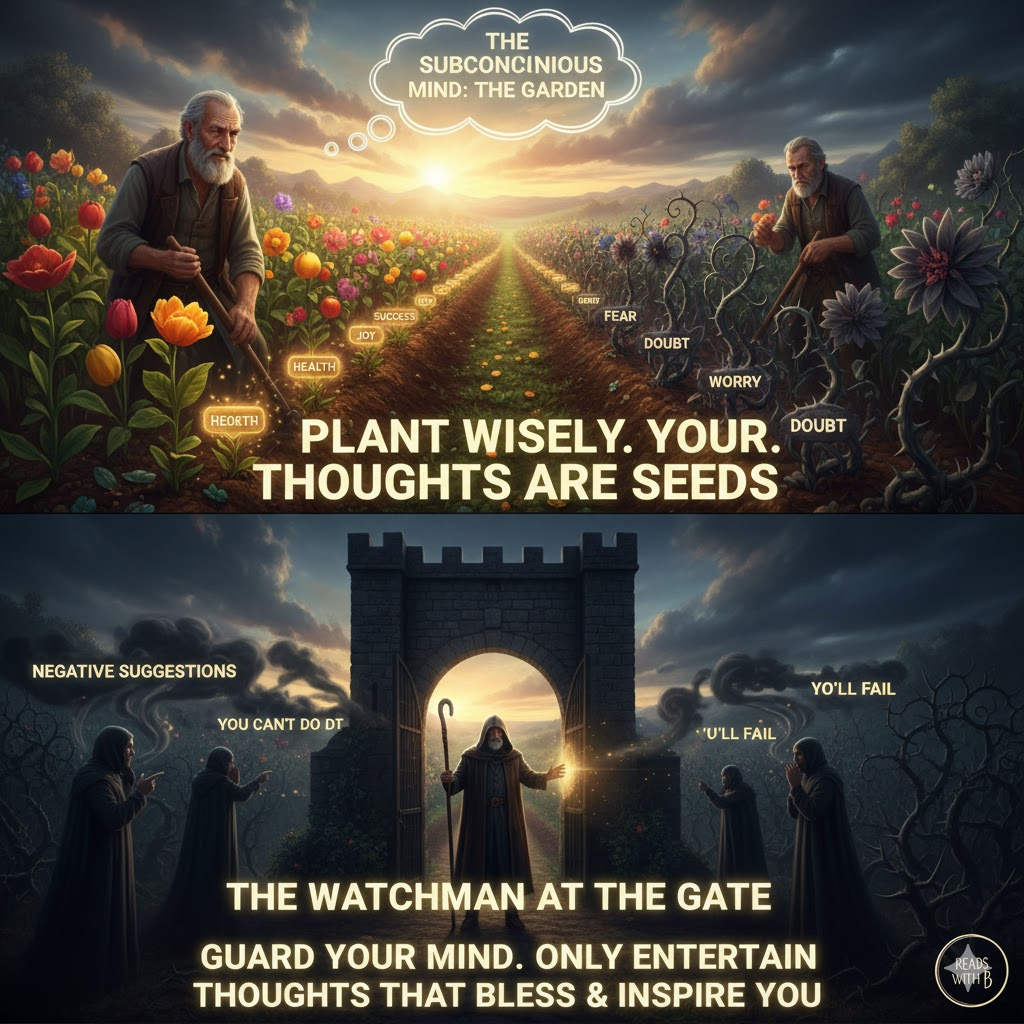
Think of your subconscious as a piece of land. If you plant seeds of fear, it doesn’t care; it will grow fear. If you plant seeds of success, it grows success.

  • Key Concept: Heterosuggestion. This is the power of other people’s words. You must learn to reject negative suggestions from others.
  • Takeaway: You are the “Watchman at the Gate.” Only let thoughts that bless and inspire enter your mind.
Chapter 3: The Miracle-Working Power of Your Subconscious

Your subconscious controls your heartbeat and breathing 24/7. It knows every cell in your body.

  • Key Concept: Subjective Logic. Your subconscious doesn’t need proof; it takes your word for it.
  • Takeaway: By telling your subconscious “I am healthy,” you provide the blueprint it needs to repair your physical body.

Chapter 4 & 5: Mental Healings (Ancient & Modern)

Whether it’s a holy relic or a modern doctor, the “healing” happens because the patient believed it would happen.

  • Key Concept: Absent Treatment. You can influence the health of others by projecting thoughts of health toward them.
  • Takeaway: It doesn’t matter what you believe in; it is the act of believing that triggers the subconscious healing mechanism.

Chapter 6: Practical Techniques in Mental Healing

Murphy outlines the “Sleep Technique.” Just before you drift off, your conscious mind is quiet. This is the best time to “whisper” your goals to your subconscious.

  • Key Concept: The Baudoin Technique. Reducing your desire to a short, phrase like “It is finished” and repeating it like a lullaby.
  • Takeaway: Don’t use willpower. Use imagination.

Chapter 7 & 8: The “Lifeward” Flow and Getting Results

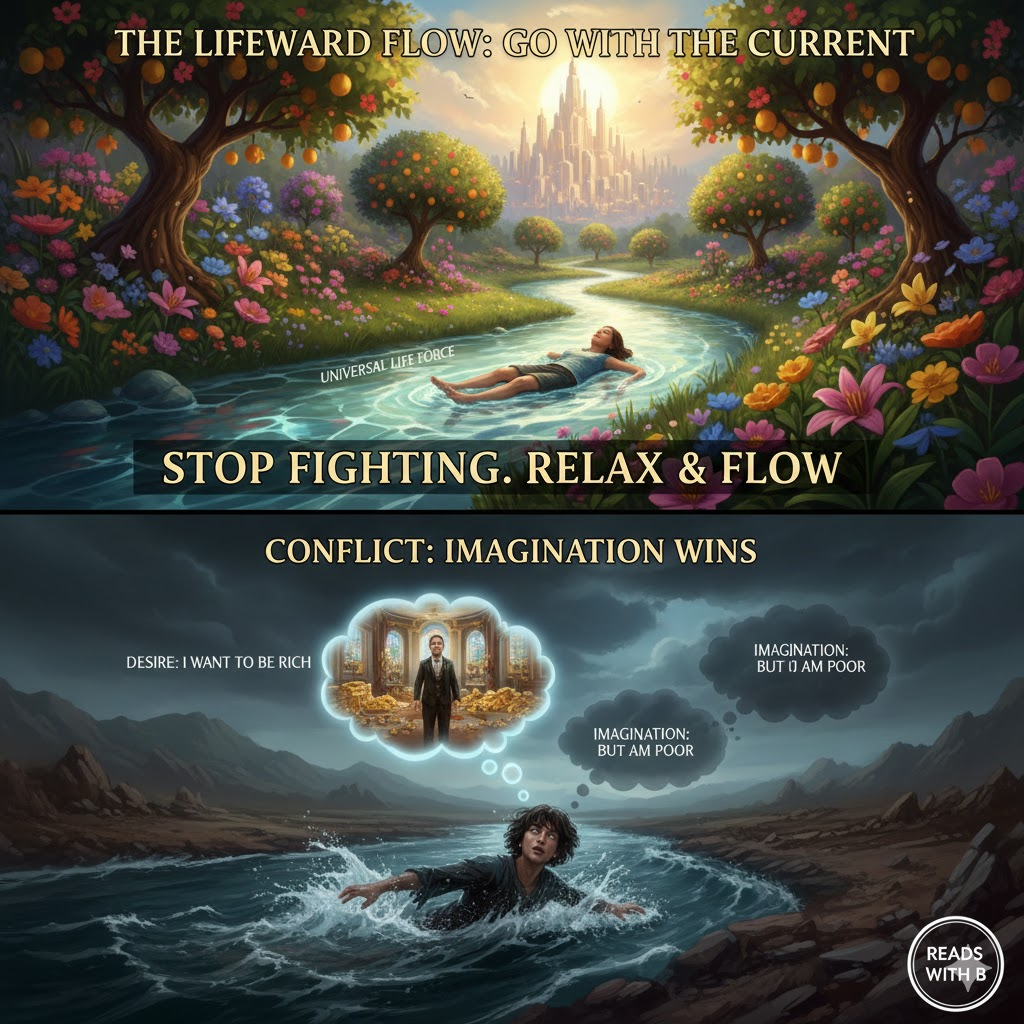
When you are sick or failing, you are fighting against the natural “Lifeward” flow of the universe.

  • Key Concept: Conflict of Desire and Imagination. If you want to be rich (Desire) but imagine you are poor (Imagination), imagination always wins.
  • Takeaway: Stop trying to force things to happen. Relax and see the end result as already achieved.
Chapter 9 & 10: Wealth and Your Right to be Rich

Wealth is simply a subconscious conviction. If you criticize rich people, you are pushing wealth away from you.

  • Key Concept: The Wealth Seed. Repeat the word “Wealth” slowly for 5 minutes before bed.
  • Takeaway: Money is a symbol. It should circulate freely in your life like blood in your body.

Chapter 11 & 12: Success and Science

Success isn’t just money; it’s peace of mind. Great scientists like Tesla used their subconscious to “see” their inventions before they built them.

  • Key Concept: The Three Steps to Success. 1. Find the thing you love to do. 2. Specialize in it. 3. Make sure your goal isn’t just for you, but for the world.
  • Takeaway: If you have a problem, ask your subconscious for the answer before bed.

Chapter 13: The Wonders of Sleep

Elaboration: You spend 1/3 of your life asleep. During this time, your subconscious is processing your day and preparing your tomorrow.

  • Key Concept: Sleep Guidance. If you have a tough decision, say “The subconscious intelligence is guiding me.”
  • Takeaway: Never go to sleep thinking about your problems; go to sleep thinking about the solutions.

Chapter 14 & 15: Marriage and Happiness

Relationships fail when people try to change their partner instead of their own mental attitude.

  • Key Concept: The Happiness Habit. Happiness is a choice you make every morning.
  • Takeaway: To attract the right partner, list the qualities you want and dwell on them. You will attract what you radiate.

Chapter 16 & 17: Human Relations and Forgiveness

You cannot be happy if you hold a grudge. Resentment acts as a “blockage” to your own success.

  • Key Concept: The Mental Mirror. How you feel about others is a reflection of how you feel about yourself.
  • Takeaway: Forgiving someone doesn’t mean you like them; it means you are letting go of the negative energy for your own sake.

Chapter 18 & 19: Removing Blocks and Fear

Fear is just a “thought in your mind.” It has no power except what you give it.

  • Key Concept: Substitution. You cannot “fight” a bad habit. You must replace it with a better one.
  • Takeaway: If you are afraid of something, do it. The subconscious will back you up once you take the first step.

Chapter 20: How to Stay Young in Spirit Forever

Elaboration: Age is not the passage of years, but the dawn of wisdom.

  • Key Concept: Mental Vitality. Keep your mind open to new ideas, and you will never grow “old.”
  • Takeaway: Retirement is a new opportunity to use the wisdom you’ve gained over the years.

💡 Key Takeaways:

  1. The Law of Belief: The law of life is not the law of “things,” but the law of belief. Your subconscious responds to what you honestly believe is true.
  2. The “Captain” Analogy: Your conscious mind is the captain. If the captain gives wrong orders (negative thoughts), the ship (your life) goes off course. You must give the order: “I am safe, healthy, and prosperous.”
  3. Visualization: If you want something, create a mental movie of it. Feel the reality of the scene in your mind until your subconscious accepts it as a fact.
  4. The Power of Forgiveness: Holding onto resentment is like taking poison and waiting for the other person to die. To heal your life, you must release others mentally.


💬 Key Quotes to Live By

“Busy your mind with the concepts of harmony, health, peace, and goodwill, and wonders will happen in your life.”

“The feeling of wealth produces wealth; keep this in mind at all times.”

“You are the captain of your soul and the master of your fate. Remember, you have the capacity to choose. Choose life! Choose love! Choose health!”

“Never finish a negative statement; reverse it immediately, and wonders will happen in your life.”

Final Tip: Dr. Murphy recommends reading this book at least three times. The first time for the concepts, the second for the techniques, and the third to make it a way of life!
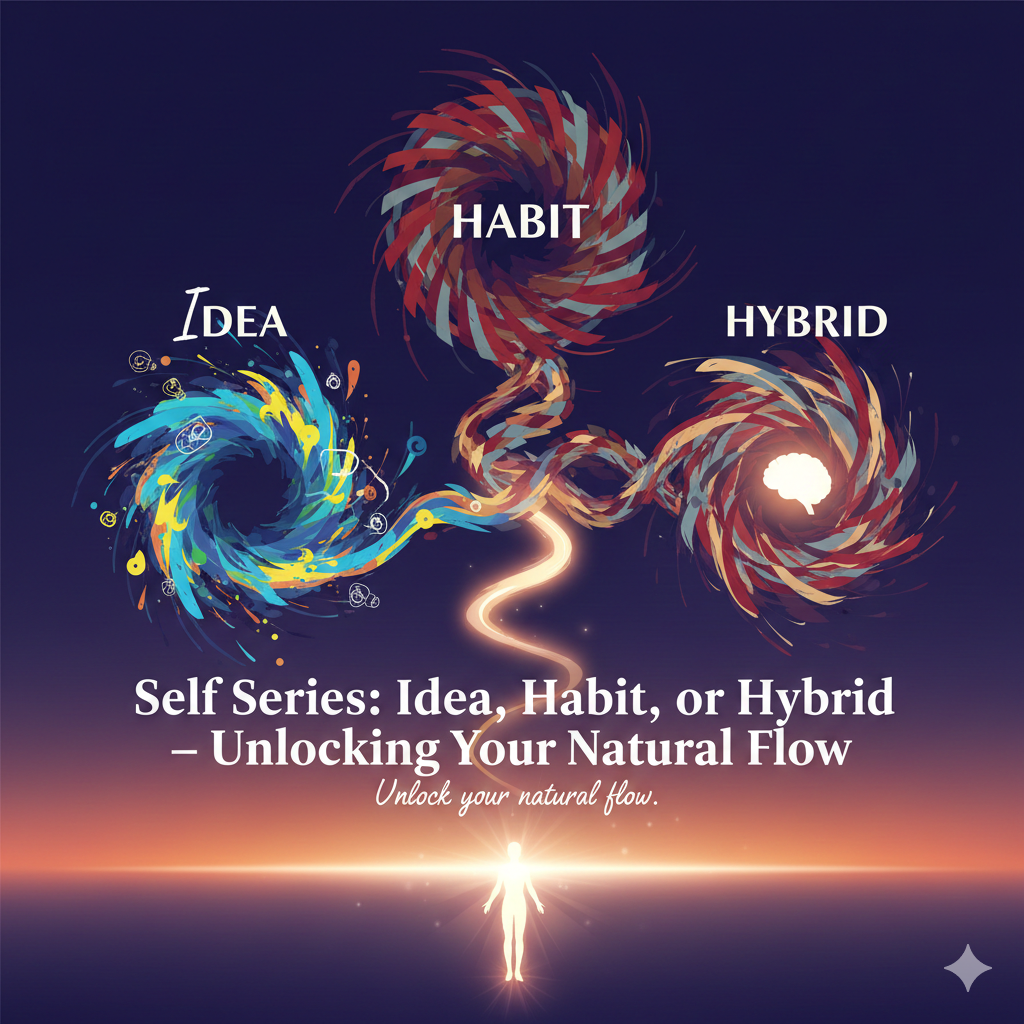
The Self Series: Idea, Habit, or Hybrid — Unlocking Your Natural Flow

Lately, I’ve been reflecting a lot on my own work style, habits, and how I interact with people. I realized something interesting: I’m Idea-driven in core, yet I instinctively expect structure and routine from others makes me Hybrid in execution and collaboration.

This got me thinking — surely, other people operate differently. Some thrive on consistency, while others, like me, thrive on inspiration. And then there are those who seem to blend both worlds.

So I decided to explore this further and write about Idea-Driven, Habit-Driven, and Hybrid personalities, and how these traits show up in leadership, family, friendships, and personal growth. My hope is that by sharing this, readers can reflect on their own style, understand how it affects their life, and learn where to leverage their strengths or be cautious.

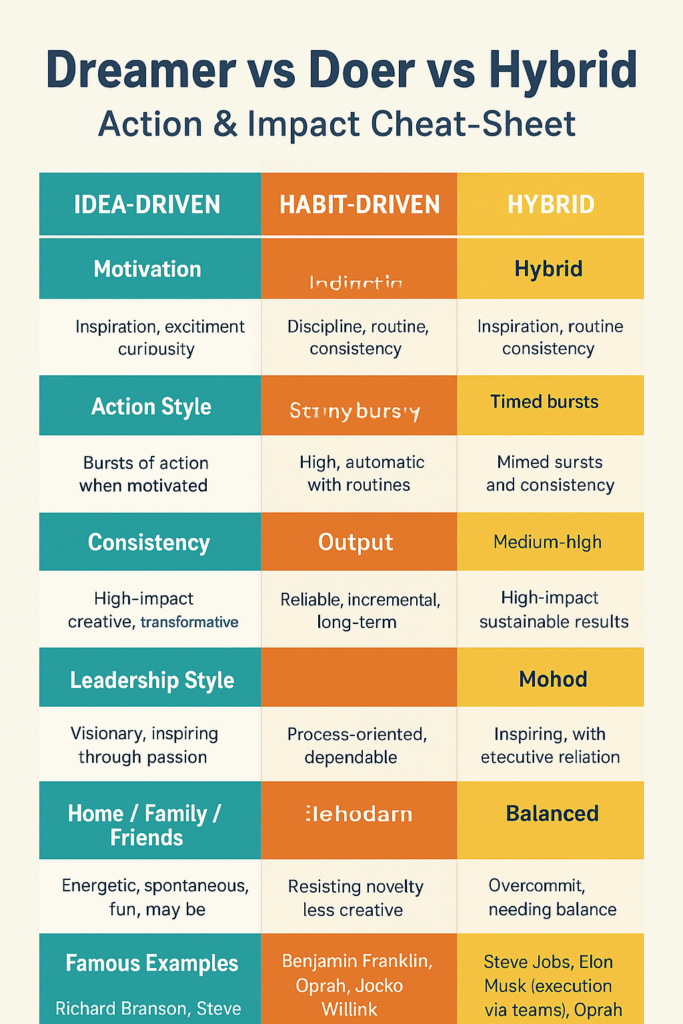
1. Idea-Driven Personalities

Traits & Approach

  • Motivated by ideas, inspiration, and creativity
  • Thrive in bursts of energy and excitement
  • Flexible, open to surprises, resistant to rigid routines

Expectations

  • From self: Freedom to act on inspiration, explore, and create
  • From others: Structure, clarity, and routine from colleagues or team members

Perception by Others

  • At work: Visionary, creative, sometimes unpredictable
  • At home/friends: Energetic, inspiring, spontaneous; may sometimes seem inconsistent

Leadership Style

  • Big-picture visionaries
  • Inspire teams through passion and innovation
  • May struggle with routine management or follow-through

Parenting & Family

  • Encourages creativity and exploration
  • Values experiences over schedules
  • Can struggle with enforcing routines

Famous Idea-Driven Achievers

  • Richard Branson – leveraged bursts of inspiration for businesses, relied on structured teams for execution
  • Steve Jobs – visionary innovation, used others’ discipline to deliver results
  • Elon Musk – pursues high-impact projects, teams ensure operational follow-through

2. Habit-Driven Personalities

Traits & Approach

  • Motivated by discipline, routine, and consistency
  • Thrive on schedules and incremental progress
  • Prefer predictability and steady outcomes

Expectations

  • From self: Follow routines consistently, track progress
  • From others: Respect schedules, minimal disruption

Perception by Others

  • At work: Dependable, reliable, sometimes seen as rigid
  • At home/friends: Predictable and supportive; may seem less spontaneous

Leadership Style

  • Structured, organized, process-oriented
  • Excellent at maintaining stable, reliable teams
  • May resist rapid change or improvisation

Parenting & Family

  • Creates predictable routines and schedules
  • Focused on responsibility and consistency
  • May struggle to allow spontaneous fun

Famous Habit-Driven Achievers

  • Benjamin Franklin – mastery through strict daily routines
  • Oprah Winfrey – disciplined routines for reflection and growth
  • Jocko Willink – military precision, leadership through consistency

3. Hybrid Personalities (Idea + Habit-Driven)

Traits & Approach

  • Blend bursts of creativity with supporting structure
  • Flexible personally, but can design systems to execute ideas
  • Thrive on both inspiration and reliable processes

Expectations

  • From self: Space for creativity, but frameworks for follow-through
  • From others: Collaboration that balances innovation and execution

Perception by Others

  • At work: Visionary yet reliable; can bridge creative and operational teams
  • At home/friends: Energetic but dependable; inspires while maintaining stability

Leadership Style

  • Combines visionary thinking with execution discipline
  • Motivates through inspiration while ensuring consistent results
  • Excellent for roles requiring innovation plus operational success

Parenting & Family

  • Encourages creativity while maintaining routines
  • Balances exploration with responsibility
  • Inspires confidence and stability simultaneously

Famous Hybrid Achievers

  • Steve Jobs – bursts of vision combined with structured execution teams
  • Elon Musk – idea-driven vision with teams to operationalize projects
  • Oprah Winfrey – disciplined daily habits while creatively innovating content

4. How Personality Affects You and Others

  • Where it matters: Career, leadership, teamwork, personal growth
  • Where it doesn’t matter: Self-worth, external validation, passion and curiosity
  • How to leverage your type:
    • Idea-driven: Harness inspiration; partner with structure for follow-through
    • Habit-driven: Maintain consistency; allow small bursts of creativity
    • Hybrid: Use vision and structure together to maximize impact

Reflection Questions:

  • Which type are you — Idea, Habit, or Hybrid?
  • How does your personality show at work, with friends, and at home?
  • Where can you leverage your strengths and where should you be cautious?

💡 Key Takeaway:
No personality type is “better” — success comes from understanding your natural tendencies, leveraging your strengths, and managing blind spots. Idea-driven, habit-driven, or hybrid — each can excel when applied thoughtfully.

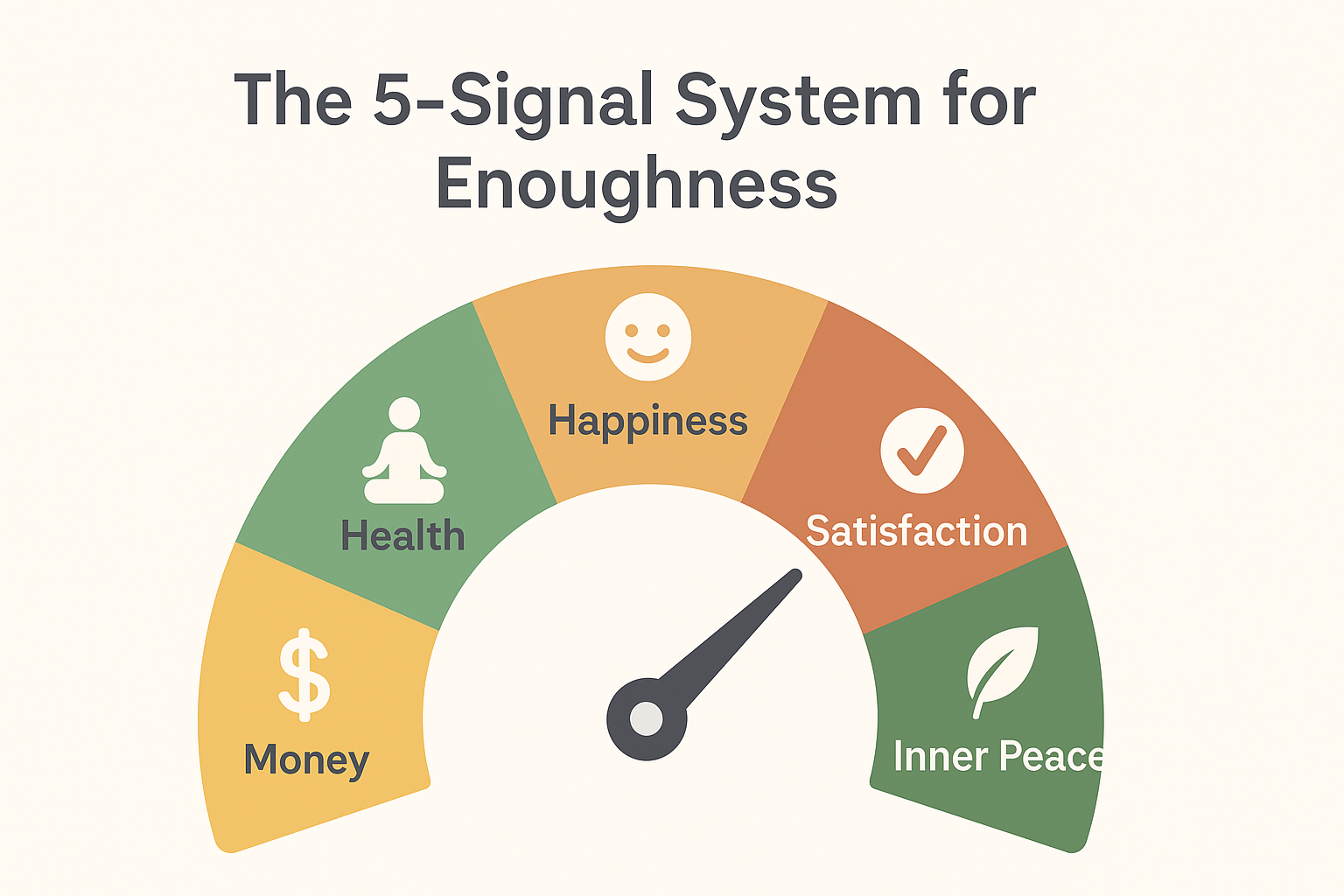
The 5-Signal System for Enoughness

We often chase more — more success, more money, more comfort — without checking if we’re already living with enoughness. This model introduces five core life signals that help you reflect on whether your life feels safe, meaningful, joyful, and aligned.

Most importantly, it clarifies why Satisfaction is separate from Money, Health, and Happiness, and how ambition can co-exist with a grounded sense of enoughness.

But very rarely do we pause and ask ourselves:

“Do I already have enough?”

The 5-Signal System for Enoughness is a gentle, practical tool to help you reflect on the areas of life that truly matter.
Not as an external checklist, but as an inner dashboard.

🌟 1. Money — The Security Signal

Money reflects stability, not status. It’s about feeling protected, having choices, and living without constant fear.

What Money “Enoughness” Means

  • Your essentials are covered without strain
  • You can handle an unexpected expense
  • You spend consciously—not emotionally

Key Question

“Do I feel financially safe and free, not necessarily rich?”


🧘‍♀️ 2. Health — The Energy Signal

Health determines the quality of your days. When your body supports you, life feels lighter.

What Health “Enoughness” Means

  • You wake up with stable energy
  • You can perform daily activities without discomfort
  • Your body feels like a partner, not a limitation

Key Question

“Is my body supporting the life I want to live?”


😊 3. Happiness — The Emotional Signal

Happiness is your emotional tone. It’s not about being happy always — but feeling joy naturally.

What Happiness “Enoughness” Means

  • You have small, frequent moments of joy
  • You can bounce back from emotional dips
  • Your mind doesn’t feel heavy every day

Key Question

“Do I experience moments of joy or ease in a normal week?”


⭐ 4. Satisfaction — The Alignment Signal

Satisfaction is not the same as happiness or money or health. It is the long-term sense of fulfillment.

It measures whether your life reflects your values, identity, and purpose — not anyone else’s.

Why Satisfaction is Separate

  • You can be happy today but unsatisfied with your life
  • You can be wealthy but feel empty
  • You can be healthy but feel you’re not living your potential

Satisfaction equals alignment — the feeling that you’re on your true path.

What Satisfaction “Enoughness” Means

  • Your efforts feel meaningful
  • Your choices reflect your values
  • You feel you’re progressing in the right direction

Key Question

“Is the way I’m living aligned with what truly matters to me?”


🍃 5. Inner Peace — The Steadiness Signal

Inner Peace is emotional grounding. It’s the feeling that your mind is not constantly fighting you.

What Inner Peace “Enoughness” Means

  • Your thoughts don’t overwhelm you
  • You recover emotionally without staying stuck
  • You can handle uncertainty without spiraling

Key Question

“Is my inner world calm enough for me to think clearly and live gently?”


⚖️ Balancing Enoughness and Ambition

Here is the truth many people misunderstand:

Ambition is not the opposite of enoughness — stagnation is.

You can feel enough and still desire growth.
You can be grateful and still aspire.

Unhealthy Ambition

  • “I’ll be enough when I achieve more.”
  • “I must constantly prove myself.”
  • “My worth depends on performance.”

Healthy, Grounded Ambition

  • “I am already enough — and I choose to grow.”
  • “My progress is meaningful, not pressured.”
  • “Ambition adds to my life, not replaces peace.”

Ambition belongs within the Satisfaction signal.
True satisfaction often includes purposeful growth.


✨ The 5-Signal Self-Check

Rate each signal from 1 to 5:

  • 1 — Very low
  • 2 — Needs improvement
  • 3 — Acceptable
  • 4 — Strong
  • 5 — Excellent
Life Signal12345
💰 Money
🧘‍♀️ Health
😊 Happiness
🎯 Satisfaction
🌿 Inner Peace

Interpretation:

  • 15 or above → You are living with strong enoughness
  • 10–14 → You have a stable foundation with room to deepen
  • Below 10 → You may be craving balance, alignment, or stability

🌱 Final Reflection

Enoughness grounds you. Ambition moves you.
A good life contains both.

When your five signals are mostly green — safety, energy, joy, alignment, and peace — you live from a place of stability. From there, ambition stops being pressure and becomes expansion.

You don’t stop growing.
You just stop growing from fear.

Stillness Speaks by Eckhart Tolle

Albert Einstein said

Stand still.  The trees ahead and bush beside you are not lost.

If we connect to the stillness within, we move beyond our active minds and emotions and discover great depths of lasting peace, contentment and serenity. Some important teachings that I learnt from the book “Stillness Speaks”.

1. Silence and Stillness

When you lose touch with inner stillness, you lose touch with yourself.  When you lose touch with yourself, you lose yourself in the world.

Stillness is awareness
The equivalent of external noise is the inner noise of thinking.
The equivalent of external silence is inner silence.

Whenever there is some silence around you – notice it.  In the moment of noticing the silence around you, you are not thinking.  You are aware, but not thinking.  When you become aware of silence, immediately there is that state of inner still alertness.  You are present.

When you look  at a tree and perceive its stillness, you become still yourself.  You connect with it at a very deep level.

2. Beyond the Thinking Mind

The human condition: lost in thought

Don’t take your thoughts too seriously.

The human mind, in its desire to know, understand, and control, mistakes its opinions and viewpoints for the truth.  You have to be larger than thought to realize that however you interpret “your life” or someone else’s life, it is no more than a viewpoint, one of many possibilities.   

When you feel bored, you can satisfy the mind’s hunger by picking up a magazine, watching TV, making phone call – Your mind is hungry for more stimulus, more food for thought.  Try to stay bored and restless and observe what is feels like.  As you bring awareness to the feeling, there is sudden space and stillness around it.  “Bored person” is not who you are.  It is simply a conditioned energy movement within you.  Boredom, anger, sadness or fear are not “yours”, not personal.  They come and go.

3. The Egoic Self

The mind is incessantly looking not only for food for thought; it is looking for food for its identity, its sense of self.  This is how the ego comes into existence and continuously re-creates itself.

Complaining and reactivity are favorite mind patters through which the ego strengthens itself.  By doing this, you make others or a situation “wrong” and yourself  “right”.  Through being “right”, you feel superior, and through feeling superior, you strengthen your sense of self.  In reality, you are only strengthening the illusion of ego.

The ego needs to be in conflict with something or someone.  That explains why you are looking for peace and joy and love but cannot tolerate them for very long.  You say you want happiness but are addicted to your unhappiness.  

If you set egoic goals for the purpose of freeing yourself, enhancing yourself or your sense of importance , even if you achieve them, they will not satisfy you.  Set goals, but know that the arriving is not all that important.

4. The Now

When you make friends with the present moment, you feel at home no matter where you are.  When you don’t feel at home in the Now, no matter where you go, you will carry unease with you.

The division of life into past, present and future is mind-made and ultimately illusory.  Past and future are thought forms, and can be remembered Now.  

5. Who You Truly Are

Self-Realization : Knowing who you are beyond the surface self – beyond your name, your physical form, your history, your story.

Most people’s lives are run by desire and fear.

Desire is the need to add something to yourself in order to be yourself more fully.

Fear is the losing something and thereby becoming diminished and being less.

You cannot find yourself in the past or future.  The only place where you can find yourself is in the Now. 

6. Acceptance and Surrender

Have you ever verbalized your inner reality  saying, “I don’t want to be where I am”? – like the traffic jam, your place or work, the people you are with etc.  It is true, of course, that some places are good places to walk out of –  and sometimes that may well be the appropriate thing for you to do.  In many cases, however, walking out is not an option.  “I don’t want to be here” is not only useless but also dysfunctional.  It makes you and others unhappy.

Do not have a reactive like/dislike  relationship in life where you are in almost continuous conflict with situation and people.  The habitual and reactive “no” strengthens the ego.  “Yes” weakens it.  You form identify, the ego, cannot survive surrender.

Doing one thing at a time – the essence of Zen

Doing one thing at a time means to be total in what you do, to give it your complete attention.  This is surrendered action – empowered action.

Surrender becomes so much easier when you realize the fleeting nature of all experiences and that the world cannot give you anything of lasting value.  You no longer demand that a situation, person, place or event should satisfy you or make you happy.  

When you no longer place an impossible demand on a situation, person, place or event becomes not only satisfying but also more harmonious, more peaceful.

Surrender comes when you no longer ask, “Why is this happening to me?”.

Acceptance of the unacceptable is the greatest source of grace in the world.  Whatever you accept completely will take you to peace, including the acceptance that you cannot accept, that you are in resistance.

Leave Life alone.  Let it be.

7. Nature

Whenever you bring your attention to anything natural, that has come into existence without human intervention, you step out of the prison of conceptualized thinking.  When walking or resting in nature, honor that realm by being there fully.  Be still.  Look.  Listen.  See how every animal and every plant is completely itself.  Unlike humans, they have not split themselves into two.  They do not live through mental images of themselves, so they do not need to be concerned with trying to protect and enhance those images.  The deer is itself.  The daffodil is itself.

8. Relationships

How quick we are to form an opinion of a person, to come to a conclusion about them.  It is satisfying to the egoic mind to label another human being, to give them a conceptual identity, to pronounce righteous judgement upon them.  Every human being has been conditioned to think and behave in certain ways – conditioned genetically as well as by their childhood experiences and their cultural environment.

When you pronounce judgement upon someone, that is not who they are, but that is who appear to be.  To let go of judgement does not mean that you don’t see what they do.  It means that you recognize their behavior as a form of conditioning, and you see it and accept it as that.  You don’t construct an identity out of it for that person.  That liberates you as well as the other person from identification with conditioning, with form, with mind.  The ego then no longer runs your relationships.

As long as  the ego runs your life, most of your thoughts, emotions, and actions arise from desire and fear.  In relationships you then either want or fear something from the other person.

What you want from them may be pleasure or material gain, recognition, praise or attention, or a strengthening of your sense of self through comparison and through establishing that you are, have or know more than they.  

What you fear that the opposite may be the case, and they diminish your sense of self in some way.  

Love does not want or fear anything. It is wonderful to go beyond wanting and fearing in your relationships.

If someone’s past were your past, their pain your pain, their level of consciousness your level of consciousness, you would think and act exactly as they do.  With this realization comes forgiveness, compassion, peace.  The ego doesn’t like to hear this, because if it cannot be reactive and righteous anymore, it will lose strength.

Most human interactions are confined to the exchange of words.  It is essential to bring some stillness, particularly into your close relationships.  No relationship can thrive without the sense of spaciousness that comes with stillness.  Meditate or spend silent time in nature together.  When going for a walk or sitting in the car or at home, become comfortable with bring in stillness together.  

If spacious stillness is missing, the relationship will be dominated by the mind and can easily be taken over by problems and conflict.  If stillness is there, it can contain anything.

The root of frequent and repetitive drama in close relationships (insignificant disagreements triggering arguments and emotional pain) lies in the basic egoic patterns:  the need to be right and for someone else to be wrong.  There is also the ego’s need to be periodically in conflict with something or someone in order to strengthen its sense of separation between “me” and the “other” without which it cannot survive.

9. Death and Eternal

When you walk through a forest that has not been tamed and interfered with by man, you will see not only abundant life all around you, but you will also encounter fallen trees and decaying trunks, rotting leaves and decomposing matter at every step.  Wherever you look, you will find death as well as life.

Upon close look, you will discover that the decomposing tree trunk and rotting leaves not only give birth to new life, but are full of life themselves.  Microorganisms are at work.  So death isn’t to be found anywhere.  There is only the metamorphosis of life forms.

Death is not the opposite of life.  Life has no opposite.  The opposite of death is birth.  Life is eternal.

Everyone is going to die, but that remains a mere mental concept until one meets death “in person” – through serious illness, or an accident of through the passing away of a love one.  Most people turn away from it in fear, but if you do not flinch and face that your body is fleeting and could dissolve at any moment, there is some degree of disidentification, from your own physical and psychological form, the “me”.  When you see and accept the impermanent nature of all life forms, a strange sense of peace comes upon you.

People tend to be uncomfortable with endings, because every ending is a little death.  That’s why in many languages, the word for “good-bye” means “see you again.”

Whenever an experience comes to an end – a gathering of friends, a vacation, your children leaving home – you die a little death.  A “form” that appeared in your consciousness as that experience dissolves.  Often this leaves behind a feeling of emptiness that most people try hard not to feel, not to face.

If you can learn to accept and even welcome the endings in your life, you may find that the feeling of emptiness that initially felt uncomfortable turns into a sense of inner spaciousness that is deeply peaceful.

By learning to die daily in this way, you open yourself to Life.

10. Suffering and the End of Suffering

Is suffering really necessary?  Yes and No.

If you had not suffered as you have, there would be no depth to you as human being, no humility, no compassion.  Suffering cracks open the shell of ego, and then comes a point when it has served its purpose.  Suffering is necessary until you realize it is unnecessary.  

Much suffering, much unhappiness arises when you take each thought that comes into your head for the truth.  Situations don’t make you unhappy.  They may cause you physical pain, but they don’t make you unhappy.  Your thoughts, your interpretations, the stories you tell yourself make you unhappy.

What a miserable day.  

He didn’t have the decency to return my call.

She let me down.

Little stories we tell ourselves and others, often in the form of complaints.  They enhance our self of being “right” and making something or someone “wrong”.  Being “right” places us in a position of imagined superiority and so strengthens our false sense of self, the ego.  

Life would be simple without  such stories.

Suffering begins when you mentally name or label a situation is some way as undesirable or bad.  Start practicing “not naming” with small things.  If you miss a plane, drop and break a cup, or slip and fall, refrain from naming the experience as bad or painful.  Naming something as bad causes an emotional contraction within you.  When you let it be, without naming it, enormous power is suddenly available to you.

© 2026 readswithb.com

Theme by Anders NorénUp ↑